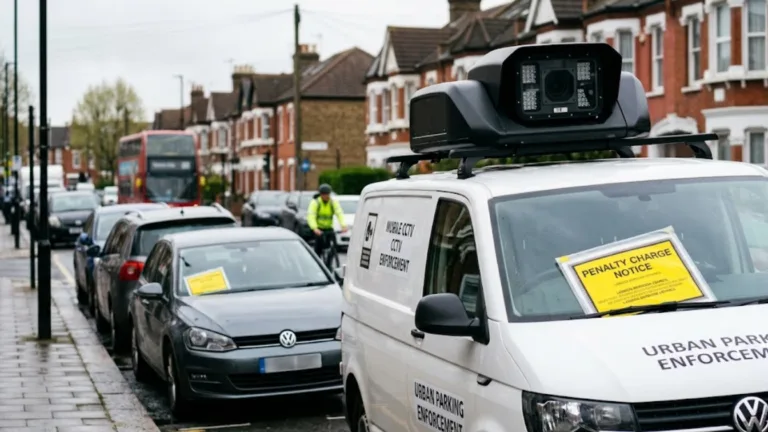
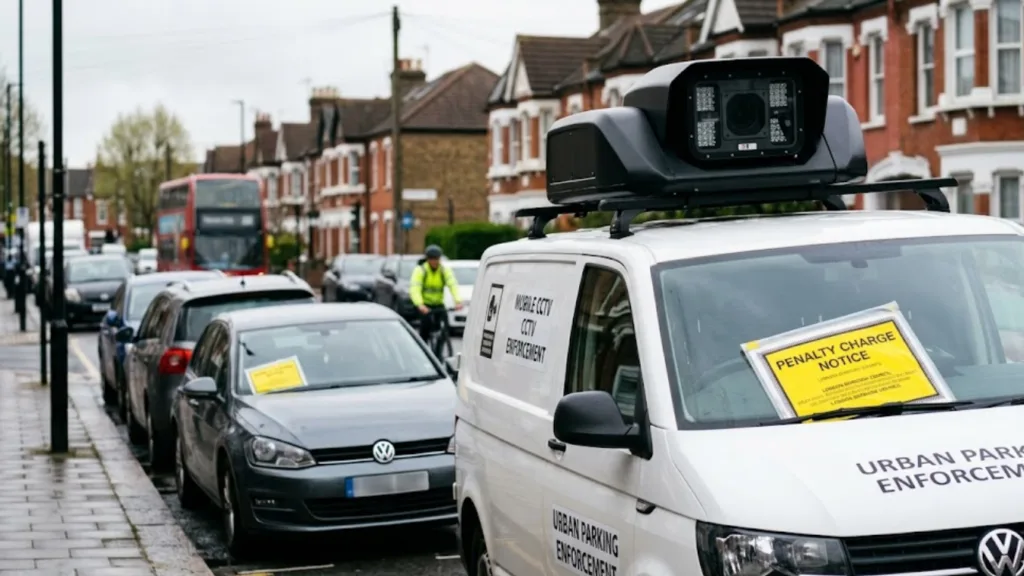
As we move into April 2026, a new wave of parking enforcement is catching British motorists off guard. While most drivers are vigilant about yellow lines and permit zones, a lesser-known regulation—dubbed the ‘20-Metre Rule’ by road safety experts—is resulting in a record number of Penalty Charge Notices (PCNs) being issued across the UK. Local councils, armed with new AI-integrated CCTV vans, are cracking down on a specific parking habit that many of us consider “harmless” but is now being reclassified as a major safety hazard.
The April 2026 Parking Crackdown: Key Facts 🚦
- AI Enforcement: Over 45 UK councils have deployed “Smart-Scan” vans that can identify 20-metre violations in milliseconds without a warden leaving the vehicle.
- The Junction Gap: Parking too close to a T-junction or crossroads is the primary target, even if there are no painted lines present.
- Safety Over Revenue: The DVSA reports that 14% of urban collisions in 2025 were caused by “obstructed sightlines” from parked cars.
- The Fine Print: Fines for this specific obstruction have risen to £130 in London and £70 elsewhere in the UK, with no “grace period” for short stays.
- Visibility Matters: It isn’t just about where your tyres are; it’s about whether your vehicle’s height obscures the view of a child or cyclist.
Did you know? Under the Highway Code Rule 243, you should not park within 10 metres (about 3 car lengths) of a junction. However, new 2026 local “Low Visibility” bylaws in cities like Manchester and Birmingham have extended this “Clearance Zone” to 20 metres for SUVs and vans to account for larger blind spots.
Why the ‘20-Metre Rule’ is Catching Out SUV Owners
The rise of the SUV in the UK has fundamentally changed road safety dynamics. In 2026, the Department for Transport (DfT) noted that larger vehicles parked near corners create “visual tunnels” that hide pedestrians. The 20-metre rule is a direct response to this. While a small hatchback might not block the view of an oncoming cyclist, a modern electric SUV acts as a literal wall.
Council wardens are no longer looking for your wheels to be over a line; they are measuring the “Sightline Corridor.” If your vehicle prevents a driver at a junction from seeing 20 metres of the approaching road, you are liable for an “unnecessary obstruction” fine. This shift from “line-based” to “vision-based” enforcement is why so many seasoned drivers are waking up to unexpected fines in the post.
The ‘Hidden’ Rule 243: It’s Not Just About Yellow Lines
One of the biggest misconceptions among UK drivers is that “no lines means I can park here.” This is a dangerous myth. Highway Code Rule 243 explicitly lists locations where you must not stop or park, including near school entrances, on a bend, or—most importantly—opposite or within 10 metres of a junction.
In 2026, the interpretation of “obstruction” has been tightened. With the introduction of the Transport Act 2025, councils now have the power to enforce these rules using remote cameras. This means you could be fined for parking in a spot you’ve used for a decade, simply because a new “Smart Camera” has been installed on a nearby lamp post that flags your car as a visibility hazard.
How to Check if Your Parking Spot is Safe
To avoid a £130 surprise, drivers are being urged to use the ‘Three-Car Rule.’ If you cannot fit three full-sized saloons between your car and the corner of the junction, you are likely within the 20-metre “Danger Zone” for larger vehicles or the 10-metre mandatory zone for smaller ones.
Furthermore, pay close attention to the new “Blue Stud” system being trialled in London and Bristol. These small, reflective blue markers on the kerb indicate where the “Visibility Zone” begins. If you park between a blue stud and a junction, you are almost guaranteed an automated fine.
The Financial Impact: Why Fines are Rising in 2026
It is no secret that UK councils are facing significant budget deficits this year. Parking enforcement has become a primary stream of “voluntary taxation.” By focusing on safety-based rules like the 20-metre visibility gap, councils can justify higher fines under the guise of Vision Zero—the international initiative to eliminate road deaths.
For the average motorist, this means the days of “popping into the shop” while parked on a corner are over. The AI vans don’t care if your hazard lights are on; they only care about the geometric obstruction your vehicle creates.
Frequently Asked Questions (FAQ)
Can I appeal a fine if there were no yellow lines? It is very difficult. Rule 243 of the Highway Code is considered “standard driving knowledge.” The absence of yellow lines does not give you permission to obstruct a junction or sightline. An appeal based on “lack of signage” usually fails in 2026.
Does this rule apply to electric vehicles (EVs)? Yes. In fact, because many EVs are heavier and larger than their petrol counterparts, they are often the primary targets for “obstruction of view” enforcement. There are no “green plate” exemptions for parking safety.
How do the AI camera vans work? These vans use LiDAR technology (the same used in self-driving cars) to create a 3D map of the street. They can instantly calculate if a parked car is obstructing the required “safe view” for a driver pulling out of a side road.
Conclusion: Protecting Your Pocket and the Road
The ‘20-Metre’ rule isn’t just another way to tax drivers—it’s a response to our changing road landscape. As vehicles get bigger and technology gets smarter, the old habits of “parking where there’s a gap” are becoming expensive mistakes.
Next time you’re looking for a spot near a corner, remember the Three-Car Rule. A two-minute walk from a safer parking space is significantly cheaper than a £130 fine. Stay sharp, park smart, and keep your eyes peeled for those AI vans.
Safe driving for 2026!